- Strategic Structuring
- Risk Mitigation
Capital Markets
- Digital Engagement
- Market Visibility
Public Perception
- Shareholders Services
- EDGAR Filings



That very same day, as Wall Street traders erupted in celebration, several individual investors who had committed more than $3 million years earlier to a dedicated “pre-IPO SpaceX private fund” received a long-awaited email from their fund manager, Owen E. H. Meyer. In a polished, reassuring note, the 35-year-old Wall Street manager urged his backers to remain patient and “await further updates regarding share distributions.”
Yet a forensic investigation by federal regulators exposed a stunning and brutal truth: on the day SpaceX rang the opening bell, Meyer’s private fund—named “Starship X”—did not hold a single share of SpaceX equity in its account. More than a year and a half before the listing, on November 19, 2024, because Meyer had refused to pay a modest $46,020 capital call issued by an upstream fund, the entire underlying SpaceX position—representing over $3 million of his investors’ principal—had already been legally forfeited by court order and transferred back to the upstream institution.
More ironic still, the Meyer case was no isolated anomaly. Just nine days after the SEC sued Meyer, on October 9, 2026, the SEC’s San Francisco Regional Office filed a sweeping civil lawsuit against two former top executives of Linqto, one of America’s largest online pre-IPO investment platforms: founder William Sarris and former CEO Joseph Endoso. Earlier, on September 2, the U.S. Attorney’s Office for the Southern District of New York (USAO-SDNY) and the Federal Bureau of Investigation (FBI) had already announced criminal charges against the pair (to which Endoso has pleaded guilty). That sprawling $430 million to $450 million scheme—ensnaring more than 13,000 individual investors worldwide—alongside the $74 million “boiler room” cold-calling markup fraud at The Spaventa Group exposed in August 2026, tore back the gilded curtain on the secondary market for Silicon Valley unicorn shares, revealing a landscape of systemic rot.
When a transformative enterprise truly exists, goes public without a hitch, and mints a trillion-dollar market capitalization, why do investors who paid handsomely for its “pre-IPO shares” end up holding worthless scraps of paper—or creditor claim forms in a bankruptcy court? In this labyrinth of capital stretching from Silicon Valley and Wall Street to high-net-worth wealth circles worldwide, how was the blinding halo of elite tech titans weaponized by intermediaries into precision bait to harvest everyday investors? To unravel this chilling series of financial mysteries, we must return to the source and dive beneath the surface of U.S. private capital markets and federal securities law—exposing the institutional walls and structural mazes deliberately omitted from the sales pitch.
Before examining fraud and contractual default, any newcomer to cross-border equity investing confronts a fundamental question: if investors believe in the future of SpaceX, OpenAI, or Anthropic, why can’t they simply buy shares in these private companies directly? The answer lies in three decades of profound structural shifts in U.S. capital markets, reinforced by a triple iron curtain of federal securities statutes and corporate governance covenants.
There was a time when a Silicon Valley tech company moved from a garage to a stock exchange in just a few short years. According to empirical studies from Harvard Law School, during the dot-com boom of 1996 to 2000, the average age of a U.S. company completing an IPO was just six years; by the early 2000s, that figure had climbed to eight years; and in the wake of the 2008 global financial crisis, the average pre-IPO lifespan crossed the ten-year mark. SpaceX pushed this trend to its absolute extreme—the aerospace giant lingered in the private market for a full twenty-four years.
That meant the hundredfold wealth dividend as SpaceX vaulted from a $10 billion valuation into the trillion-dollar stratosphere was released almost entirely during its private phase prior to going public. Yet when individual investors tried to crowd into the lane, they found the doors to primary institutional funding rounds bolted shut against retail capital. That acute anxiety—watching trillions of dollars in wealth compound inside the fortress walls while being locked outside—created the most fertile psychological soil for every pre-IPO investment scam.
If primary direct issuances are off-limits, how do intermediaries legally—or quasi-legally—peddle private company stakes to individuals? This touches the bedrock of U.S. federal securities law: the Securities Act of 1933. Aside from Regulation Crowdfunding—which imposes a strict investment cap ($124,000 ceiling) on non-accredited investors—the vast majority of private funds and intermediaries rely on the “safe harbor” provisions under Section 4(a)(2) of the Securities Act of 1933: the famed Regulation D (Reg D), and specifically Rules 506(b) and 506(c).
When it comes to concrete fundraising rules, Rules 506(b) and 506(c) draw starkly different red lines. Yet in countless pre-IPO roadshows pitched to high-net-worth individuals and North American retail investors, promoters love to pull up the SEC’s official EDGAR database, point to a Form D on the screen, and solemnly declare: “This dedicated SpaceX fund is officially registered with and approved by the SEC—it is 100% compliant and safe!” In reality, this is a classic sleight of hand exploiting cross-border legal information asymmetries.
As a matter of law, Form D is merely a free, post-sale “notice filing” submitted online to the SEC by a private issuer within 15 days after the first sale of securities. As the SEC warned in its Investor Bulletin: Private Placements under Regulation D (updated September 21, 2026), the SEC never “approves” any securities offering, and any promotion equating a Form D filing with “SEC approval or registration” is itself a glaring red flag of fraud.
Even if a high-net-worth individual fully satisfies accredited investor standards, uses a broker to locate an early SpaceX or OpenAI employee eager to sell shares to buy a house, and willingly signs a share transfer agreement, will the transaction actually close? The answer is still no.
Unicorn management teams never allow early employees to freely sell stock to unfamiliar outside retail buyers. On one hand, allowing employees to prematurely cash out floating equity incentives into fixed cash weakens long-term performance alignment; on the other, if the external shareholder count spirals out of control, the company could be forced to trigger mandatory public reporting obligations under the Securities Exchange Act of 1934, while letting competitors or activist investors infiltrate its capitalization table (cap table). Consequently, virtually all Silicon Valley unicorns embed two tight lines of defense into their corporate charters and shareholder agreements.
The first line of defense is executive and board transfer approval. Empirical surveys show that among companies permitting employees to transfer vested options or shares, a full 86% require internal approval for the transaction, while only 14% impose no approval threshold.
The second, and far more lethal, line of defense is the Right of First Refusal (ROFR). Whenever an early employee or existing shareholder attempts to sell SpaceX shares to an external third party, the seller must first formally present the agreed-upon price and terms to SpaceX; SpaceX (or its designated existing major inside shareholders) holds a legal right of first refusal to step in and buy those shares on the exact same price and terms—shutting external buyers out completely.
Because getting an outsider’s name onto SpaceX’s cap table was next to impossible, financial engineers on Wall Street and in Silicon Valley turned to a legal instrument that is legitimate on its face yet extraordinarily easy to abuse: the Special Purpose Vehicle (SPV). From that moment on, the deceptively simple promise of “buying pre-IPO SpaceX shares” underwent a breathtaking legal bait-and-switch.
Before dissecting SPVs, we must clarify a financial concept routinely used by unscrupulous intermediaries to muddle the waters: when everyday investors discover that their names are not on SpaceX’s official cap table and raise questions, salespeople often draw an analogy to public markets—claiming it is no different from buying Apple stock at Charles Schwab or Interactive Brokers, where retail investors’ names do not appear on Apple’s shareholder register either, and insisting that such “nominee holding” does not affect their substantive rights.
That analogy is a textbook half-truth. In the U.S. public securities market, investors hold shares of listed companies in three primary legal ways. The first is a Physical Certificate, where the investor is recorded directly on the issuer’s books and receives a paper certificate. The second is the Direct Registration System (DRS), which uses paperless electronic book-entry registration. The third—and by far the most common among U.S. retail investors—is “Street Name” Registration, where the nominal holder recorded on the public company’s books after a purchase is a depository nominee (such as Cede & Co.) or a licensed broker-dealer.
Yet holding Apple stock in “street name” through a licensed brokerage firm in the public market and buying a “private SPV fund interest” that purports to hold SpaceX in the private market are worlds apart in legal rights, regulatory rigor, and liquidity. Within a private SPV structure, what the investor buys is not SpaceX stock at all, but a membership interest or limited partnership interest in a Delaware or New York limited liability company (LLC, including a Series LLC) or limited partnership (LP). Inside that private black box, underlying backers typically enjoy zero shareholder voting rights or direct information rights in the target company; the safety of their assets hangs entirely on the moral integrity, cash-flow health, and a series of opaque private agreements of the SPV manager (GP/Manager).
In a compliant venture capital ecosystem, a single-layer SPV is a normal pooled investment vehicle (often called a syndicate or acquisition vehicle): a deal lead who secures a direct allocation from the target company establishes an independent SPV, pools capital from dozens of accredited investors, and enters the unicorn’s cap table as a single legal entity—helping the unicorn keep its shareholder register clean while lowering the minimum investment threshold for individual backers.
When a trillion-dollar prize like SpaceX ignited a global capital frenzy while Musk strictly locked down official allocations, however, a runaway game of “financial nesting dolls” proliferated in the shadows. In the years preceding SpaceX’s IPO, at least 170 separate SPV vehicles dedicated specifically to SpaceX emerged in the market. Because the vast majority of small and mid-sized private fund managers could never get onto SpaceX’s official tender offer list, they could only buy partial sub-interests from a “Primary SPV (Layer 1)” that had already secured an allocation, and then repackage them into a “Secondary SPV (Layer 2)” to sell downstream; downstream players repeated the trick, slicing and repackaging the exposure into a “Layer 3 SPV,” a “Layer 4 SPV,” and even a “Layer 5 SPV.”
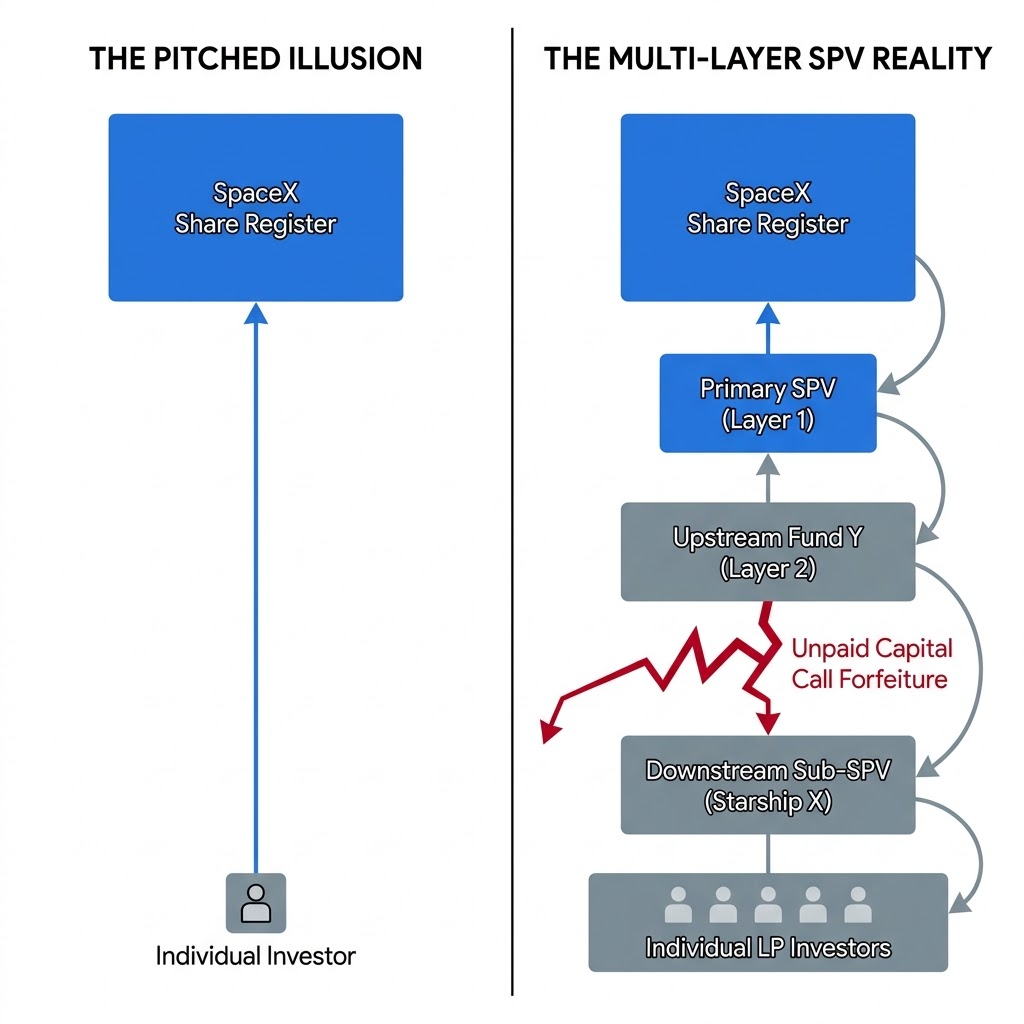
Figure 1: The Pitched Illusion vs. The Multi-Layer SPV Reality—illustrating how an unpaid upstream capital call severs the entire downstream equity chain.
Inside this five-layer Russian nesting-doll labyrinth, information transmission degenerated into an absurd game of “telephone”: along this fragile chain, the safety of an underlying investor’s assets depends not on whether SpaceX succeeds at the very top—so long as any single intermediate layer suffers misappropriation, default, or an unauthorized transfer, the underlying investor’s equity vanishes in an instant.
Worse still, some purported “pre-IPO allocations” do not even qualify as multi-layer SPVs; they are far more legally perilous forward contracts, tokenized claims, or derivative revenue-interest assignments. Under U.S. federal securities law and contract law, many such “forward nominee agreements” held by retail investors face severe compliance hurdles—often implicating unlawful public offerings, lock-up circumvention, and violations of corporate transfer restrictions—leaving them highly prone to becoming unenforceable risk exposures in court.
Once the fragile architecture of multi-layer SPVs is understood, looking back at the lawsuit filed by the SEC on September 30, 2026 against Meyer Global Management LLC (MGM) and its CEO Owen E. H. Meyer makes the mechanism of the entire tragedy unmistakably clear. The case stands as a textbook specimen of multi-layer SPV governance failure and the betrayal of fiduciary duty.
The details disclosed in the complaint sketch a cautionary portrait of a “Wall Street micro-private-equity shop.” Thirty-five-year-old Owen Meyer resides on Long Island, New York, and founded Manhattan-based Meyer Global Management LLC (MGM) alongside an affiliated entity, Meyer Equity (owned 50% each by Meyer personally and MGM). In terms of internal governance, Meyer was at once MGM’s founder and CEO, its sole shareholder, its sole managing member, and its sole full-time employee. From investment decisions, daily fund operations, and financial wire transfers to investor relations, all authority rested in Meyer’s hands alone, with no independent risk committee or external compliance checks and balances.
Trading on the halo of legendary companies like SpaceX and OpenAI, starting with the formation of “Starship I” in November 2019 and continuing through 2024, Meyer raised at least $18.5 million cumulatively from nearly 100 individual (retail) investors across a series of dedicated SPV funds named under the “Starship” and “MGP” banners. Yet according to the SEC’s allegations, from December 2021 onward, Meyer and MGM severely breached their fiduciary duties to the funds they managed across at least five separate fraudulent schemes—not only fabricating false information for investors, but brazenly misappropriating at least $1.27 million of client funds for luxury personal spending, entertainment venue expenses, personal investments, and plugging financial holes in other affiliated entities.
Among the five charges in the Meyer case, what shocked the legal and financial communities most was not his squandering of client funds on personal lifestyle expenses, but the catastrophic forfeiture of assets—a textbook case of losing a fortune over a pittance—that befell Starship X.
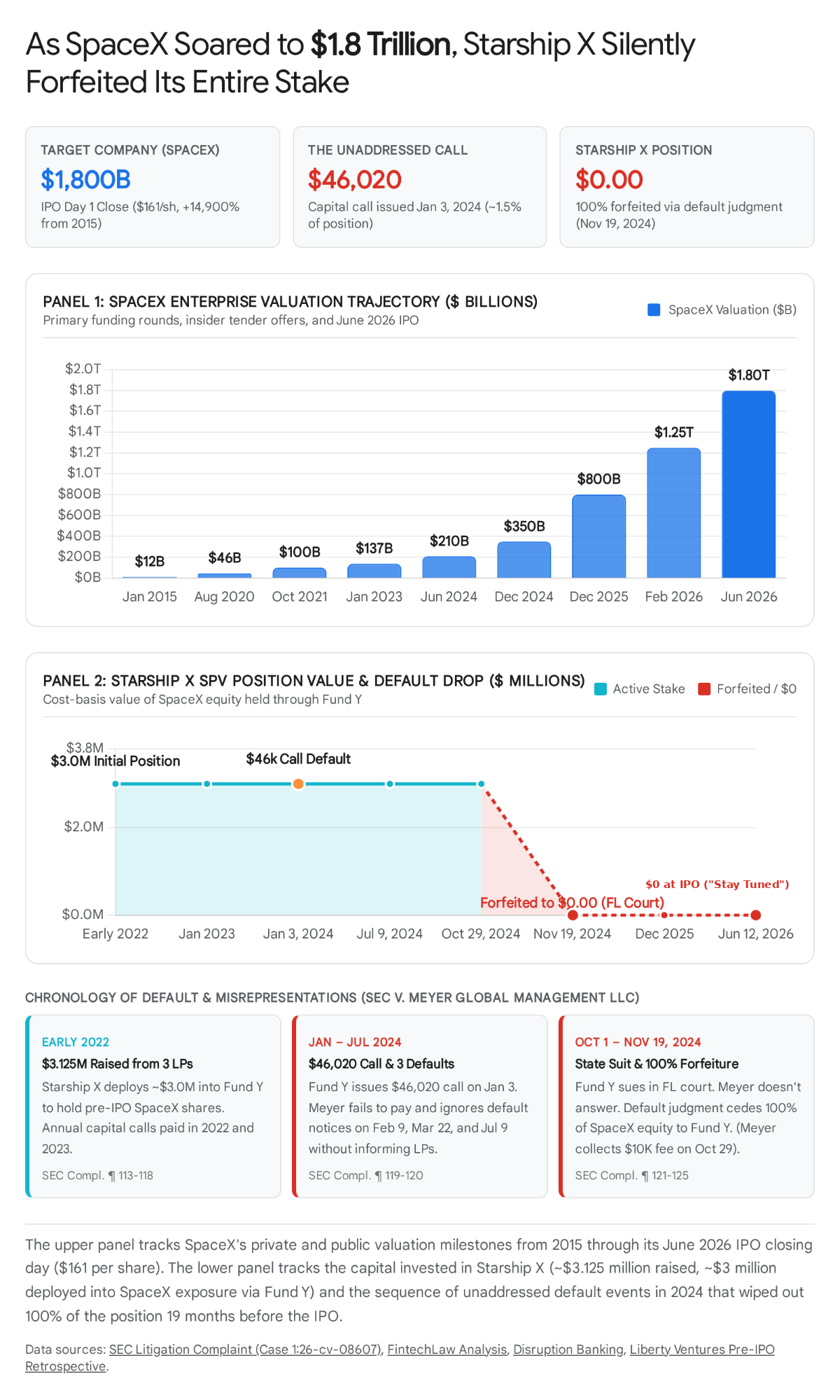
Figure 2: SpaceX’s enterprise valuation trajectory toward its $1.8 trillion IPO alongside the 2024 default sequence that wiped out 100% of Starship X’s $3 million stake.
To readers unfamiliar with U.S. private equity law, the notion that “failing to pay a $46,000 fee resulted in the total confiscation of $3 million in principal” sounds almost surreal—do American courts really refuse pro-rata deductions for arrears and enforce outright “total confiscation” instead? In fact, this is precisely one of the most lethal legal mechanisms built into U.S. private fund Limited Partnership Agreements (LPAs).
Because Meyer himself could never secure a direct allocation from SpaceX, Starship X signed subscription agreements (“Fund Y Agreements”) with an upstream fund—Fund Y—managed by a third-party Investment Adviser C.
The turning point arrived on January 3, 2024: Fund Y issued a routine capital call notice to Starship X in the amount of $46,020. Yet Meyer, by then deeply mired in cash misappropriation, neither paid the sum from the fund’s management account nor ever informed Starship X’s three investors of the capital call notice.
On October 1, 2024, an exasperated representative of Fund Y formally filed a default lawsuit against Starship X in Florida state court. On November 19, 2024, the Florida state court entered a default Declaratory Judgment, ruling that 100% of the SpaceX-related interests held under Starship X’s name were transferred to Fund Y for zero consideration—reducing Starship X’s underlying assets to zero overnight. And after the default judgment took effect in December 2024, across the ensuing 19 months, Meyer continuously concealed from Starship X’s investors the truth that their underlying equity had been stripped away; even on June 12, 2026, the very day SpaceX went public, he was still sending notices to clients—including that very group of investors—falsely claiming that future share distributions were moving forward.
Looking back at this series of financial tempests at the turn of late summer and autumn 2026, nothing is more poignant than the darkly comic juxtaposition of time and space: on the launchpads of Texas, SpaceX engineers were working tirelessly to propel human civilization toward a multi-planetary future among the stars; meanwhile, in office towers in New York and California, the likes of Owen Meyer and William Sarris were erecting one fragile house of cards after another.
Why did so many well-educated investors with multi-million-dollar net worths drop their guard so effortlessly when confronted with “pre-IPO SpaceX shares” or “insider OpenAI allocations,” stepping straight into legal traps that were hardly sophisticated?
Behavioral finance attributes this to cross-domain transference of the “Halo Effect.” In modern commercial society, disruptive technology enterprises like SpaceX and OpenAI have long transcended the bounds of ordinary business corporations to become technological totems and emblems of faith in our era.
The only antidote to the halo effect of marquee companies is to rebuild an iron firewall between commercial judgment and verification of legal title. Believing in a company’s voyage to the stars can only ever serve as the starting point of investment research; what truly determines whether a sum of capital can safely reach the far shore and return bearing fruit is always the structural integrity of the legal vessel beneath your feet.
Only when market participants learn to scrutinize every page of a partnership agreement and every closing transfer receipt with the same unforgiving rigor applied to rocket blueprints will the predators and vultures nesting in the shadow of great enterprises finally lose the breeding ground on which they thrive.
1. SEC, Meyer Global Management LLC and Owen E. H. Meyer, civil complaint, September 30, 2026. Paragraphs 6, 35–40 and 113–132. The Florida judgment is described through this complaint, https://www.sec.gov/files/litigation/complaints/2026/comp-pr2026-98.pdf
2. SpaceX, IPO closing announcement, June 15, 2026, recording the June 12 trading debut, https://ir.spacex.com/updates/releases-details/2026/Space-Exploration-Technologies-Corp--Announces-Closing-of-Initial-Public-Offering-Including-Full-Exercise-of-Underwriters-Option-to-Purchase-Additional-Shares-2026-RgoR-Y1Vwh/default.aspx
3. FINRA, Know the Risks of Pre-IPO Funds and Potential Fraud, August 18, 2026, https://www.finra.org/investors/insights/pre-ipo-risks
4. Investor.gov, Updated Investor Bulletin: Investing in an IPO, October 14, 2022, https://www.investor.gov/introduction-investing/general-resources/news-alerts/alerts-bulletins/investor-bulletins-17
5. SEC, William Sarris and Joseph Endoso, Litigation Release No. 26672, October 9, 2026. The release describes allegations in the SEC civil action, https://www.sec.gov/enforcement-litigation/litigation-releases/lr-26672
6. Investor.gov, Private Placements under Regulation D – Updated Investor Bulletin, August 17, 2022, https://www.investor.gov/introduction-investing/general-resources/news-alerts/alerts-bulletins/investor-bulletins/private-placements-under-regulation-d-updated-investor-bulletin
7. Linqto Founder Charged Over $450 Million Pre-IPO Scheme as Ex, https://es.tradingview.com/news/financemagnates:893a45d6f094b:0-linqto-founder-charged-over-450-million-pre-ipo-scheme-as-ex-ceo-pleads-guilty/
8. Who Invested in SpaceX Before the IPO? A Retrospective, https://www.libertyventures.vc/learn/spacex-pre-ipo-retrospective
9. The Regulatory Consequences of the Oscillating Domains of Public, https://www.ecgi.global/sites/default/files/2024-11/the-regulatory-consequences-of-the.pdf
10. Private-Company Exchanges and Employee Stock Sales Prior to IPO, https://corpgov.law.harvard.edu/2018/10/09/cashing-it-in-private-company-exchanges-and-employee-stock-sales-prior-to-ipo/
11. How much carry and fees are normal for a pre-IPO SPV? - Esploro, https://www.esploro.group/private-markets/structures/spv-fees-and-carry/
12. Private Placements under Regulation D – Updated Investor Bulletin, https://www.investor.gov/introduction-investing/general-resources/news-alerts/alerts-bulletins/investor-bulletins/private-placements-under-regulation-d-updated-investor-bulletin
13. Glossary: All - Investor.gov, https://www.investor.gov/introduction-investing/investing-basics/glossary/all
14. Investor Bulletin: Holding Your Securities, https://www.investor.gov/introduction-investing/general-resources/news-alerts/alerts-bulletins/investor-bulletins-97
15. SpaceX SPV Fraud: SEC Charges and the $3M Capital Call Loss, https://fintechlaw.ai/blog/spacex-spv-fraud-sec-charges-and-the-3m-capital-call-loss
16. Meyer Global Management LLC and Owen E. H. Meyer - SEC.gov, https://www.sec.gov/files/litigation/complaints/2026/comp-pr2026-98.pdf
17. Pre-IPO Investing — A Major Shift for Everyday Investors - StartEngine, https://www.startengine.com/blog/pre-ipo-investing
18. Fact Sheet - Eliminating the Prohibition on General Solicitation and, https://www.sec.gov/news/press/2013/2013-124-item1.htm
Disclaimer: This article is for informational and research purposes only and does not constitute any investment advice.
 U.S. IPO Trends, SPAC Activity, and Listing Regulatory Rules